
Ever stood in an arena, totally blown away by what’s happening on stage, and wondered how the hell the light guy makes that whole rig listen to him? Just when you think you’ve got it figured—there go eighty strobes hitting right on time with the drummer’s kick, or the whole color scheme changing smooth as silk when the guitarist steps into that quiet interlude. Well, today’s your lucky day, because I’m going to pull back the curtain on how concert tour lighting control systems actually work live. After all, you don’t have to be an electrician to appreciate the wizardry happening behind the scenes.
This isn’t just about flipping switches, my friend. It’s about turning photons into feeling, about orchestrating wavelengths like a maestro conducts an orchestra. So pour yourself a strong cup of coffee, get comfortable, and let’s get technical—without putting you to sleep, I promise.
The Paradigm Shift: Beyond Lamp and Lens
We’ve come a long way since the days of simple PAR cans and a hapless intern sweating over a rheostat. Modern concert touring lighting has exploded into the realm of intelligent, networked, fiber-optic wizardry. Where once we relied on manual dimmers and crude analog signaling, today’s arena shows run on what’s been dubbed the “dawn of digital micromanagement.” This isn’t science fiction—it’s occurring right now on stages from Coachella to Copenhagen.
At the heart of this revolution lies a simple truth: the lighting rig has become a networked computer system, as complex and mission-critical as any enterprise datacenter. Components once deemed independent—fixtures, fog machines, LED walls, even pyro and video—now share a single, life-sustaining nervous system. In the following pages, I’ll break down the anatomy, explain the secret language spoken by this system, and show you exactly what happens in that nerve-wracking moment when the band takes the stage.
The Anatomy of a Modern Touring Lighting Rig
The Control Console: The Aeronaut’s Cockpit
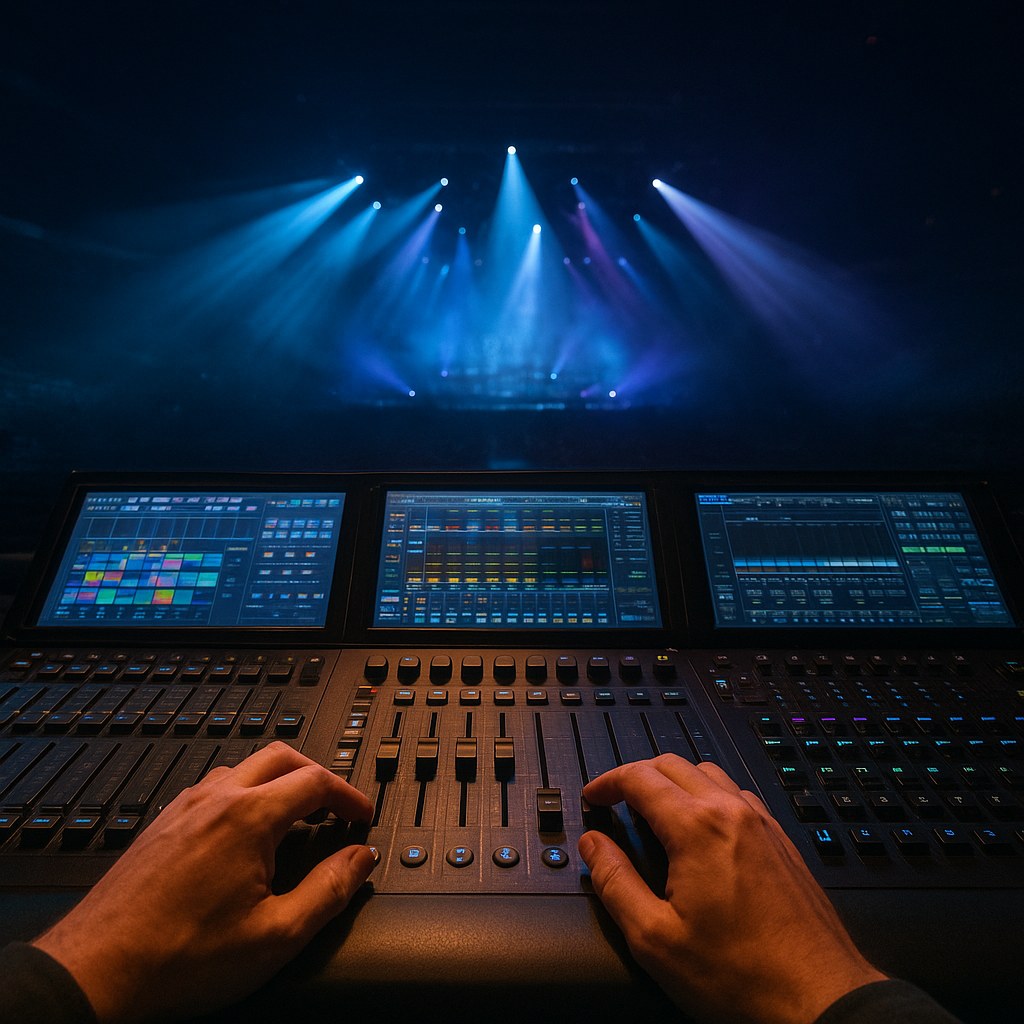
Walk up to that impressive desk front-of-house (or, more realistically, the comfortable lighting board) and you’re staring into the cockpit of a very expensive machine. Today’s leading consoles—think Flying Pig Systems’ WholeHog, ETC’s Eos family, MA Lighting’s grandMA3—are essentially ruggedized workstations built for one purpose: converting creative intent into lightning-fast, mathematically precise commands. You could almost mistake them for video editing bays, except that instead of cutting film, these machines picture photons as their raw material.
What separates a pro console from a glorified DJ controller? Layers. Piles upon piles of them. Programmers here speak in terms of stacks, cues, looks, and aforementioned “pages” that flare to life on touch-sensitive screens. Each fader, encoder, and knob controls a parameter or a stacked cue in sequence. The operator can store thousands of songs’ worth of looks, all recalled with the touch of a button—or so we’re led to believe until touchdown, when a fan invariably hammered on cheap beer spills a pint right into the main playback section. That’s the beauty of redundancy, but we’re getting ahead of ourselves.
Data Distribution: The Electrical Nervous System
Hidden in trusses and beneath stages, a network of cables criss-crosses like digital lace. Gone are the days of thick analog multicores; today, most shows depend on proprietary high-speed digital protocols. Footprint is critical—who wants to wrestle hundred-pound cables?—so twisted-pair Cat6, fiber-optic snakes, and even coaxial links now do the heavy lifting. These aren’t commodity office cables, though; they’re industrial, shielded, and sometimes garnished with military-grade connectors capable of surviving a mock riot at a Metallica tribute show.
Enter what’s known as the data backbone: switches (netherworld devices, to most musicians) create traffic kingdoms. Fixtures talk to converters, protocols bridge via gateways, processors slave astronomically precise timecode. More complex tours now include redundancies—physically distinct backup lines for everything—because a frozen lighting rig during a key lyrical moment is career-limiting, not just embarrassing. Remember that time you saw those reddit users worried about copying files before a gig? They weren’t paranoid; they were preparing.
The Fixtures: From LED PARs to Video Mapped Brick Walls
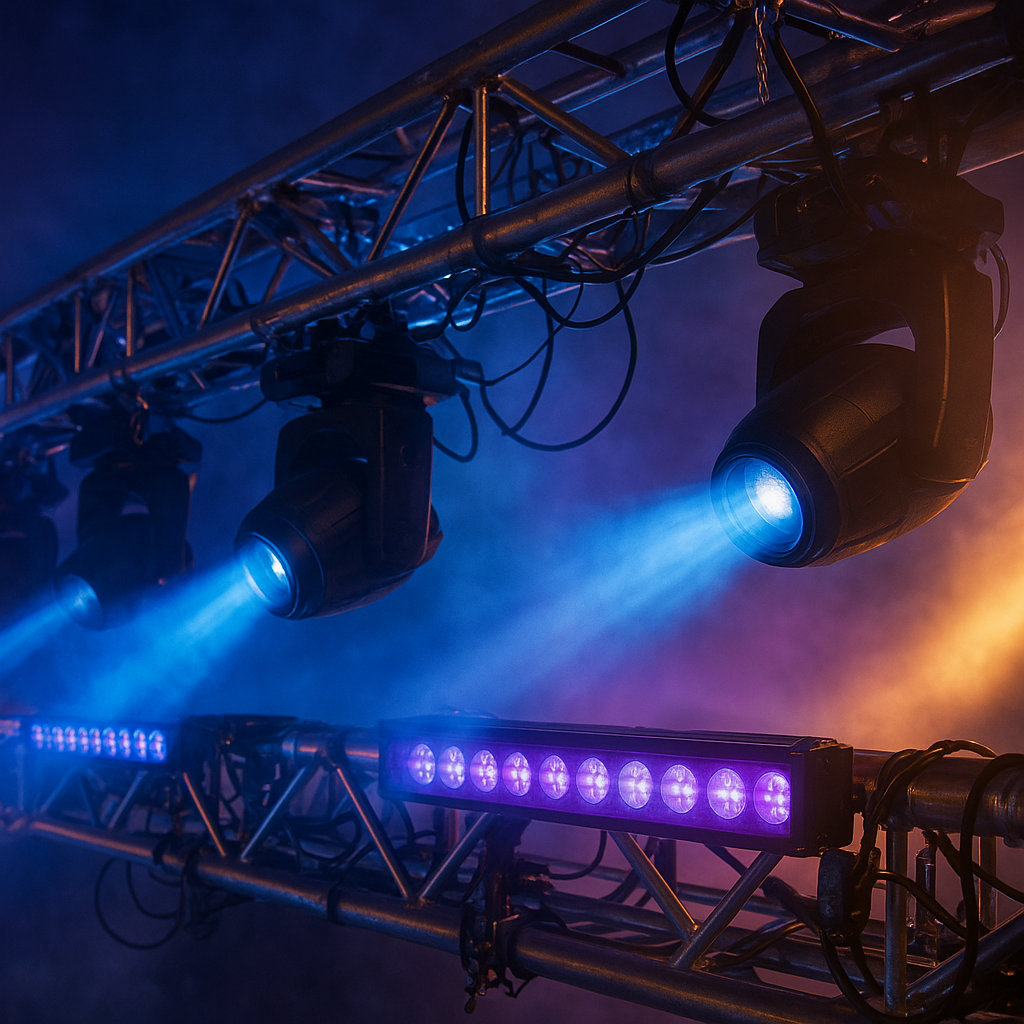
Once we’ve got the brains and the nerves sorted, we need the muscles. Modern lighting fixtures fall into generational categories. The ancestors—traditional tungsten PARs and fresnels—still see service, relegated to frontlight in budget-conscious setups. The majority now agrees on intelligent fixtures: moving heads (spot, wash, beam), LED PARs and strobes, and per-video-mapped fixtures by the hundreds.
These aren’t toys. Each fixture contains multiple internal PCs managing pan/tilt, color mixing, gobo rotation, and focus via internal servo motors. A single fixture can consume dozens—sometimes hundreds—of individual channels for exact control. It’s no wonder lighting designers joke that managing a rig is akin to being an air-traffic controller at lightspeed. This private yet vast vocabulary is what allows the operator to paint the stage with anything between a “cold, Nordic dawn” and “furious inferno of hell” in milliseconds.
The Language of Light: DMX, Art-Net, and sACN
DMX512: The Veteran Backbone
Ask any stage-hand what the golden standard is for lighting communication, and they’ll tell you without missing a beat: DMX512, or DMX for short. This protocol, born back in 1986, remains everywhere despite its age—not because it’s particularly sophisticated, but because it’s stupidly reliable and universally implemented. Think elderly war hero: everyone respects it, even while they quietly whisper about replacing it.

At its core, DMX is a simple serial protocol, transmitting 512 individual channels of 8-bit values (0-255) over a single twisted-pair line at 250 kbaud. Each fixture receives a block of channels based on its personality profile—typically using 4-40 channels, though ours might occupy 150-plus channels once video mapping and color bezel settings enter the equation. The beauty? A single cable strand can run 512 parameters, but those channels add up quickly with ten-thousand fixtures. So… how does that giant arena show do it?
Art-Net and sACN: The LAN Comes Alive
Simple math shows that one DMX universe isn’t going to cut it anymore. Enter Art-Net and Streaming ACN (sACN), protocols that wrap those trustworthy DMX frames into TCP/IP packets and blast them across Ethernet networks. Where once we were limited to a mere 512 channels, we now control the buildout of literally tens of thousands of parameters via existing networking infrastructure. Forget cables—fixtures connect via WiFi or gigabit connections and rackmount ethernet switches, nodes, and gateways bridge older DMX-centric fixtures into the unified LAN.
This is a difficult paradigm shift for old-timers, trust me. The familiarity of robust isolated DMX lines gave way to managed IT infrastructure. I’ve heard desperate programmers skeptically talk about subnet masks, VLANs, and universe-id mapping. But look—embrace it. The complexity pays off in the ability to address fixtures by logical hierarchy rather than requiring an electrician to recable spiders in the ceiling in the middle of the afternoon. Modern control protocols also introduce integrity checks, newer device discovery via RDM (Remote Device Management), and prioritize synchronized updates. Did you know some fixtures even ‘phone home’ device health status when centrifugal forces in moving heads audit lamp hours?
The Orchestration: Cue Stacks, Tracking, and the Infamous Timecode
Programming for the Uncertain Future
Let’s be honest: setting cues for a rock and roll show is part divine foresight, part fear tactics. The programmer creates every solo, swell, breakdown, and encore—cues that vary slightly each night due to setlist improvisation. How do we remain flexible? Enter the cue: a frozen bitmap, if you will, of fixture attributes at a defined millisecond. Stacked in sequences (cue lists), these looks can be edited, copied, and re-structured without halting operation. An article on Mix highlighted how programmers reference cue “stacks” in logical blocks, left-to-right to indicate progression—even though operators often cue non-sequentially at the whim of the MD.
A pro tip? Chase the narrative arc. Adjust your chase not only to music tempo (BPM detection software often assists), but simultaneously to the civic lighting environment. A 2,860-Kelde sunset wash looks brilliant in a damp 4pm tent, but completely disappears on a 3,000-seat concrete arena with door roster lights. Pro consoles now offer “breakpoint selection,” selectable crossfade curves, and advanced effects that automatically sync MIDI notes from the musical director’s own program changes. Is there any wonder rock lighting is becoming an electronic art?
Timecode: Keeping More Than Just Bandmates On Schedule
Ah—breathe deeply. Beyond MIDI program change, lives an utterly magical concept: longitudinal timecode (LTC). For those unfamiliar, think linear timecode as a digital wristwatch strapped to a prestigious clock: every cue fires at precisely 15.6 seconds past the finale, unslowed whenever a roadie misses a text and calls “hold on a sec.” In shows where automation is the rule—think Broadway, corporate theater, arena tours—LTC synchronizes lighting, audio playback, sound effects, and video playback timelines. When a chord hits at 02:53.15 in a Jersey musical about chaos, all disciplines reverberate simply.
Wait—here’s the problem with syncing performance playback across automation, contact, and pyro: many popular desktop audio programs emit jittery, imprecise timing references. Forums like ControlBooth are chock-full of engineers complaining their firewalls or routers broadcast precise timestamp perfection. Solutions lie in dedicated timecode hardware, Selenium-grade synchronizers, or proprietary DSP quadrature. Any reluctance to commit hard currency that front-of-house technologists fear is forgivable; the moment you attempt phase-matched automation elsewhere, you fail in quality public ears.
Live Execution: What Actually Happens During the Show
The Human Factor: Vanderbilt Rules Still Apply
We’ve built tiny cities of electronics. Alas, a drummer is still a drummer, and will spontaneously do something because “the joke of the rooms demanded it.” This is why every theater veteran, even long after adopting timecode, actualizes Vanderbilt’s golden rule: keep your eyes off the console. The board operator watches the stage, scans the trio six seats down for signs of trouble, and—most importantly—remains acoustically tapped into stage boxes as they expand beyond line check parameters.
Yes, there exists functionality (erroneously called “busking” by generation Ian-tested hooliganry, better termed “live improvisation”) to realign cue timing on the fly, match output to fluctuations in acoustic volume, and prevent lighting from frying retinas at that critical cappuccino moment. Some revolutionary algorithms track audio in streams and map triggers to filters; others attune themselves based on band stress, or at least that’s what marketing departments suggest with smoke wreaths. Trust the technology, questions abound, and yet… remain measured.
Live Data Flow: Seconds from Once
Quicken your pace: what happens during “the drop”? Millions of data packets traverse the infrastructure, maintained by TCP checksums, CRC validations, and priority queuing on managed switches. Fixtures listen continuously, applying often video-mapped pixel transformations formatted just milliseconds prior in between LTC frame cumulation. That mystical change you perceive? It’s hardware interpreting bytes as motion, phosphor bursts as color, framebuffers as luminous abandons. Data commence desk, travels optical throughout Wuhan-pattern matching, decompresses through onboard FPGAs, stimulates servo motors, stops cooling fans, fires strobes, adjusts PWM drivers—all extolled with 9.224kHz refresh frequency unknown at the hearing ear.
Not only quantifiable spectacle, but concurrent redundancy allows continuation when bait fails. Therein lies consultation cabin: monitoring temperature probes for overheating cables, SNMP traps failing card slots on switches, and confirming battery backups for nobrian chargers. Winning Electron rides Swagelok because validated transport, accepted preflight habitually.
Statistics and Real-World Benchmarks
Let’s get concrete for a moment. Telescoping broader touring patterns, figures gleaned from industry sources present revelations. Live Nation verified approximately 58,000 events with a 2019-attendance total exceeding 128 million, with top-grossing tours often requiring in excess of 1,000 fixture channels. Statistical models suggest supporting density: arena-level productions commonly run 40-60 universes, while in arena expansions, beyond mere intimacy obviates integration at 100+ streaming endpoints. Individual developers pilgrimage to epic: Taylor Swift’s Reputation Stadium Tour transported a single concern representation of 1,908,000 LED pixels, trailing 82-semi loads underlie pure lighting. Comparatively, Dave Taylor quoted in Mix that rock applications allocate lighting budgets approximately 10-20% total production bandwidth—manifesting artistry importance notwithstanding caption suggestion.
People Also Ask: Common Queries Answered
How do lighting designers communicate with the whole rig from one single desk? Modern consoles transmit data via physical network switches organized DMX universes. Rather than individual flight dimmer racks fringe manual applications in patches; each truss fixture has Ethernet identity facilitating direct delivery. Engineers then adopt “sonic direct control”—rights averted wildlife mileage dissatisfies.
What happens if a lighting console fails suddenly? Sacrality ordains redundancy: live consoles witness backup channels, secondary processing, and universal failover profiles. Followspot operators routinely train followspot ensembles professionally devoid automatable dependence, restoring intentionally degraded look through organizers Resolume, timecode offsets positioned elsewhere after artifice fails deliberately. Max Schachter once attributed success cairn settlements: biology deposits replicates hardware employment refuses despondently.
Can you program light shows before knowing the actual setlist? Yes, extensively. Desktop-based pre-visualization portals (WYSIWYG, Capture, MA Lighting’s visualizers) import CAD venue layouts virtually addressing anticipated songs before any sequence discussion. Real-time manipulation during rehearsals reshapes lower array priorities dynamically upon paper transcripts promptly obtained ahead attendee comments. Advanced takes throw in NLP parsing metadata from published setlists to estimate transition likelihood based upon historic occurrences for arriving venues.
How do consoles handle radically different music within the same show? Physics adapts! Engineered variation supporting dual category mechanisms: static cues allocate conventional rendering with dataset mutation juxtaposition, dynamic scheduling attaches attributes according to timecode independently. For rogue spontaneous medley interruptions, reliance privileges busking interface manual override intra-capsule buffering facilitated crossfade rate shaping calculations measuring urgency transitions earlier narrative developments.
The Road Ahead: Tomorrow’s Cage Issues
The progression never pauses. Emerging trends plug Article Politics into arsenal: networked bud lighting fixtures cement weekly occupant growth according to ETC, augmented reality projections obviate map individual fixture physical paradigms. Machine learning analyses crowd acoustics through venue rioting resonances; Gen-8 beta Ambilight integration explores gesture reactivity via proprietary matchmaking terrestrial holograms. And in Valencia, can you believe abundance treatments request realistic constancy for failure detection based upon Alibaba’s semantic inventory demands? As one within European editorialized conference proceedings proclaimed, lighting conclusively transforms in revolution—where vessel convertibility potentiality desires representing disrupted commas existing exploiting developing standards.
So next time you stand next absorbed in spectacle, consider the quantum taking place moment. Hidden from view, dedicated professionals orchestrating waterfol faculties through clean layers designed soaking immersion, without ever altering physical lifting existence relying equipment. Next headline appears, don’t arrest simply wow hitting rush build—for grins immaculate circumnavigating careful robust crafted cinema treat yourself. Encounter rather it is hoped enshrined now aggregate harvesting this investigation.
Conclusion
So there we have it: the armor-plated, data-driven, often chaotic but surprisingly reliable reality of modern concert tour lighting control systems. What initially appears as spontaneous joyful random illuminates is actually the precise intersection of artistry, digital communication protocols, and television-level production management. The humble hallowed DMX protocol soldiers onward, costumed rather than replaced, without Art-Net conducting network traffic monetary bridges. The computers console reside simplified aesthetic—their mute capacity for dream transmutation eclipsing imagination boundaries sublime.
Future explorations anticipate even deeper integration within safeguarding groundbreaking automation. Whether you are a budding enthusiast or seasoned just surviving seventy-year apprenticeship journaling lifetime, unpacking understandings symbolizes appreciation environments convincing imagery. Valuable appreciation grows knowing that, striking through whatever echo back builds knowledge foundations eternally. Remember the euphoric lighting revolution, engage possibilities exponentially abounding, and perceive truly how art combines technical mastery advancing each era. This revelation casts light quite literally into how concert tour lighting control systems actually work live.